

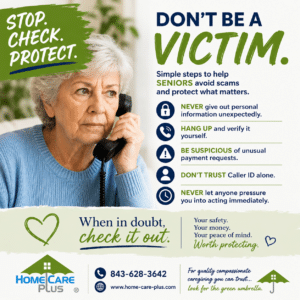
Scams targeting older adults are becoming increasingly sophisticated. A fraudulent phone call may appear to come from a bank. A text message may look like it came from a delivery company. Someone may claim to represent Medicare, the government, law enforcement, or a utility company.
Even more concerning, scammers may pretend to be a child or grandchild experiencing an emergency and urgently ask for money.
For seniors and families throughout Mount Pleasant, Charleston, and the Lowcountry, knowing how to recognize the warning signs of fraud is an important part of helping aging loved ones remain safe and independent.
At Home Care Plus, we believe senior safety involves more than physical safety in the home. Helping aging adults recognize potential scams and protecting their personal and financial information matters, too.
Why Can Scams Be So Convincing?
It’s important to remember that falling victim to fraud isn’t necessarily a matter of intelligence or judgment.
Today’s scammers can be extremely convincing.
They may already know someone’s name, address, family members, or other personal information. Technology can also make fraudulent calls and messages appear legitimate.
Scammers frequently try to create an emotional response. They want the person receiving the call to feel afraid, excited, worried, or rushed because someone under pressure may act before having time to verify what’s happening.
That’s why one of the most valuable fraud-prevention habits is incredibly simple:
Stop before you respond.
If something feels urgent or unusual, give yourself permission to hang up, walk away, and verify it independently.
1. Never Give Personal Information to an Unexpected Caller
Seniors should be cautious about providing sensitive information when someone contacts them unexpectedly.
This includes:
-
Social Security numbers
-
Medicare or insurance information
-
Bank account or credit card information
-
Passwords
-
PIN numbers
-
Account verification codes
Even if the caller seems to know personal details about you, that does not necessarily mean the call is legitimate.
If you’re uncertain, end the conversation and contact the organization directly using a trusted phone number.
2. Don’t Automatically Trust Caller ID
Seeing the name of your bank, a government agency, or a familiar local number on your phone can feel reassuring.
Unfortunately, Caller ID can be manipulated.
A safer rule is:
Don’t verify the caller. Verify the organization.
For example, if someone says they’re calling from your bank, hang up. Find the phone number printed on your bank card, statement, or official website and call the bank yourself.
3. Be Suspicious of Unusual Payment Requests
How someone asks you to pay can be one of the biggest warning signs of a scam.
Be especially cautious when someone insists on payment through methods such as:
-
Gift cards
-
Cryptocurrency
-
Wire transfers
-
Cash
-
Payment apps to an unfamiliar person
-
Money sent by courier or mail
If someone tells you that you must immediately purchase gift cards to pay a bill, resolve a government issue, help a relative, or avoid arrest, stop and verify the situation before sending anything.
4. Watch for Pressure and Urgency
Scammers don’t want you to have time to think.
Warning phrases may include:
“You have to pay right now.”
“Don’t hang up.”
“Don’t tell your family.”
“Your account will be closed.”
“You’ll be arrested if you don’t pay.”
“Your grandson is in trouble.”
“This opportunity expires today.”
Any request that combines money + secrecy + urgency deserves extra scrutiny.
A legitimate organization should allow you time to independently verify what you’re being told.
5. Create a Family Fraud Plan Before You Need One
Families don’t have to wait until something suspicious happens to discuss scams.
Have the conversation now.
One of the most reassuring things an adult child can tell an aging parent is:
“If anyone ever calls asking you for money or personal information, call me first. You will never be bothering me.”
That sentence matters.
Older adults may sometimes hesitate to contact their children because they don’t want to interrupt them or feel like they’re asking for help unnecessarily.
Make it clear that you want the call.
Consider Creating a Family Safe Word
Families can also establish a private word or phrase known only to close family members.
If someone calls claiming that a child or grandchild has been injured, arrested, stranded, or otherwise needs emergency money, the senior can ask for the family safe word.
However, a safe word shouldn’t replace independent verification. The safest approach is still to hang up and contact the family member directly using a phone number you already know.
6. Be Careful With Links in Text Messages and Emails
A message may say:
Your package couldn’t be delivered.
There’s suspicious activity on your bank account.
Your account has been locked.
You have an unpaid toll.
Click here to verify your information.
Don’t automatically click.
Instead, independently open the company’s official app or website, or call the organization using a trusted number.
7. What Should You Do If You Think You’ve Been Scammed?
Act quickly.
Contact the bank, credit card company, or financial institution involved and explain what happened. Depending on the circumstances, they may be able to freeze an account, stop a transaction, replace a card, or take other protective measures.
Change compromised passwords and continue monitoring financial accounts.
Suspected fraud can also be reported to appropriate authorities, including the Federal Trade Commission at ReportFraud.ftc.gov.
And perhaps most importantly:
Don’t shame someone who was scammed.
Scammers deliberately manipulate emotions and trust. Embarrassment can make an older adult less likely to tell family members when something happens—and that can allow fraud to continue.
Instead of asking:
“How could you fall for that?”
Try:
“I’m glad you told me. Let’s figure out what we need to do next.”
Family Members: Watch for Changes
Families can also pay attention to unusual financial behaviors, particularly when helping an aging loved one.
You may notice:
-
Unexpected withdrawals
-
Unusual purchases
-
Multiple gift cards
-
Unfamiliar subscriptions or recurring charges
-
New “friends” frequently requesting money
-
An unusual number of sweepstakes or prize notifications
-
A loved one becoming secretive about financial conversations
-
Statements that someone told them not to discuss a transaction with family
These signs don’t automatically mean fraud is occurring, but they may be worth a gentle conversation.
How In-Home Care Can Provide Another Set of Eyes
A professional caregiver isn’t a financial advisor or fraud investigator. However, in-home care provides something valuable that families can’t always provide themselves: regular presence.
A caregiver spending time with a client may notice changes in routines or behaviors that family members who live elsewhere don’t see every day.
For example, a caregiver might notice that a client is becoming unusually upset after repeated phone calls, receiving suspicious-looking correspondence, or frequently purchasing gift cards.
When something seems unusual, appropriate communication with the family can provide an additional layer of awareness.
At Home Care Plus, our caregivers provide non-medical senior home care throughout Mount Pleasant, Charleston, and surrounding Lowcountry communities. Whether we’re assisting with personal care, meals, transportation, companionship, household tasks, or everyday routines, our goal is to help aging adults remain as safe, comfortable, and independent as possible at home.
Remember These Three Words
When an unexpected call, text, email, or message asks for money or personal information:
STOP. HANG UP. VERIFY.
Don’t use the number the caller gives you.
Don’t allow someone to rush you.
And don’t be embarrassed to ask a trusted family member for a second opinion.
Taking five extra minutes to verify something could help protect a lifetime of savings.
Need Additional Support at Home?
If your family is beginning to worry about an aging loved one living alone—or Mom or Dad could simply benefit from another set of caring hands—Home Care Plus is here to help.
We provide compassionate, non-medical in-home care for seniors and aging adults in Mount Pleasant, Charleston, and throughout the Lowcountry.
For quality compassionate caregiving you can trust… look for the green umbrella

Home Care Plus is an in-home elder care and support service whose goal is to help elderly clients live life as fully and safely as possible in the comfort of their own homes. We offer a wide range of services to meet a variety of needs. Our mission is to provide quality supportive services and care coordination to our clients to assist them in leading dignified and independent lifestyles in the comfort and safety of their own homes.
We provide a comprehensive ongoing needs assessment by a Registered Nurse identifying an individual’s and his/her support system’s strengths, weaknesses, limitations, objectives and service needs. With the focus on health, psychosocial and environmental factors we develop an individualized plan of care based on the needs assessed. The plan of care is tailored to fit changing needs and thoroughly reviewed with the client, family members and/or responsible parties.
We provide a comprehensive ongoing needs assessment by a Registered Nurse identifying an individual’s and his/her support system’s strengths, weaknesses, limitations, objectives and service needs. With the focus on health, psychosocial and environmental factors we develop an individualized plan of care based on the needs assessed. The plan of care is tailored to fit changing needs and thoroughly reviewed with the client, family members and/or responsible parties.
Latest posts by Home Care Plus Staff (see all)
- Breast Cancer in Older Adults: Powerful Signs Every Family Should Know - October 13, 2026
- The Powerful Benefits of Breast Cancer Awareness and Long-Term Care Planning for Seniors - October 6, 2026
- Healthy Aging: Essential Steps for Senior Wellness - September 30, 2026