

National Preparedness Month: Helping Aging Adults Prepare for Emergencies in the Low country!
September is National Preparedness Month, an important reminder for families to think ahead before an emergency occurs.
Here in the Charleston Low country, emergency preparedness is especially important. Hurricanes, tropical storms, flooding, severe weather, and extended power outages can disrupt everyday life quickly. For an aging adult who relies on medications, mobility assistance, medical equipment, transportation, or help from a family member or caregiver, those disruptions can create additional challenges.
Preparing doesn’t mean living in fear of the next storm. It means having a plan so that when something unexpected happens, everyone knows what to do.
At Home Care Plus, we encourage families to include their aging loved ones in emergency planning and consider the everyday needs that can easily be overlooked.
Why Emergency Preparedness Can Be Different for Older Adults
A standard emergency checklist is a good place to start, but aging adults may have needs that require additional planning.
Consider whether your loved one:
Takes daily medications
Uses a walker, wheelchair, cane, or other mobility device
Needs assistance with bathing, dressing, toileting, or transfers
Has Alzheimer’s disease or another form of dementia
Lives with Parkinson’s disease or another condition affecting mobility
Uses medical or assistive equipment that requires electricity
Has hearing or vision loss
No longer drives
Lives alone
Relies on family members or caregivers for everyday assistance
Has a pet that would need to evacuate with them
The question isn’t simply, “Does Mom have emergency supplies?”
It’s also:
“If Mom couldn’t stay safely in her home tomorrow, what exactly would we do?”
That’s where a detailed plan becomes important.
1. Build an Emergency Kit Before You Need It
Don’t wait until a storm is approaching and stores are crowded to begin gathering supplies.
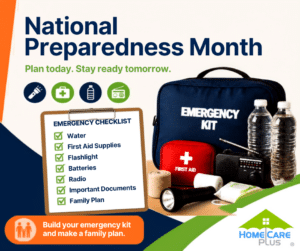
An emergency kit for an older adult might include water, nonperishable foods, flashlights, batteries, a battery-powered radio, phone chargers or backup power banks, personal hygiene products, first-aid supplies, copies of important documents, and necessary mobility or personal-care supplies.
Keep everything somewhere that is easy to access.
If your loved one has difficulty lifting or carrying items, consider dividing supplies into smaller containers rather than placing everything in one heavy bin.
2. Make a Medication Plan
Medications can become a significant concern when pharmacies close, roads are inaccessible, or a family has to evacuate unexpectedly.
Keep an updated list that includes:
Medication names
Dosages
When medications are taken
Prescribing physicians
Pharmacy name and phone number
Allergies
Important medical conditions
Keep a copy with your loved one’s emergency information and consider having another trusted family member maintain a copy.
Before a significant storm, families should also determine how necessary medications will be obtained if normal routines are disrupted.
3. Create an Emergency Information Sheet
During an emergency, you don’t want to search through paperwork or someone’s phone looking for important information.
Create one easy-to-find document containing essential contacts and information, such as family members, physicians, pharmacy, insurance information, emergency contacts, medication information, allergies, and other important care information.
If your loved one receives in-home care, include the appropriate care provider contact information as well.
Make sure more than one family member knows where this information is located.
4. Decide Who Is Responsible for What
One of the biggest weaknesses in an emergency plan can be assuming someone else is handling something.
Instead of saying:
“We’ll make sure someone checks on Dad.”
Decide specifically:
Who will check on Dad? When will they call? Who will pick him up if he needs to leave? Where will he go? Who will bring his medications and supplies?
Assigning responsibilities ahead of time can reduce confusion when everyone is under pressure.
5. Have an Evacuation Plan
For families in Mount Pleasant, Charleston, and surrounding Low country communities, evacuation planning deserves particular attention during hurricane season.
If evacuation becomes necessary, determine in advance:
Where will your loved one go?
Consider a family member’s home, hotel, shelter, or another predetermined location.
Then determine how they will get there.
An older adult who doesn’t drive, has limited mobility, or needs assistance getting in and out of a vehicle may require more planning than another family member.
Don’t forget to consider how walkers, wheelchairs, medications, personal-care supplies, and other necessities will travel with them.
6. Prepare for a Power Outage
An aging adult may be able to remain safely at home during a brief power outage—but what happens if it lasts overnight or several days?
Consider lighting, temperature, refrigeration, communication, food preparation, and any equipment your loved one relies upon.
During hot Low country weather, losing air conditioning can become especially concerning for older adults.
Families should have a plan for when remaining at home is no longer the safest option.
If someone depends on electrically powered medical equipment, discuss emergency planning with the appropriate healthcare provider and equipment supplier before an outage occurs.
7. Make the Plan Dementia-Friendly
Emergency situations can be particularly difficult for someone living with Alzheimer’s disease or dementia.
Changes in surroundings, unfamiliar people, disrupted routines, loud weather, evacuation, and family stress can contribute to confusion or anxiety.
When possible, bring familiar items such as a favorite blanket, photographs, familiar snacks, comfortable clothing, or another reassuring object.
Keep explanations calm and simple.
Most importantly, don’t assume that a loved one with dementia will understand or remember emergency instructions given earlier.
Their plan should include who will physically be there to help them.
8. Don’t Forget Pets
For many seniors, a pet is an important source of companionship—and leaving that pet behind may not feel like an option.
Include pets in the emergency plan from the beginning.
Have food, water, medications, identification, vaccination information, a leash or carrier, and other necessary supplies ready.
If the evacuation plan involves a hotel, shelter, or family member’s home, determine ahead of time whether the pet can come too.
9. Create a Family Communication Plan
Emergencies become much more stressful when family members don’t know what’s happening.
Decide ahead of time who will serve as the primary contact.
Family members should know:
Who is checking on the aging adult
Whether they are remaining home or evacuating
Where they will go
Who is providing transportation
Who has medication and medical information
How updates will be shared
A family group text can work well but consider a backup plan if cell service or internet access becomes unreliable.
10. Practice the Plan
An emergency plan is much more useful when everyone understands it before it’s needed.
Have a conversation with your aging loved one and walk through different scenarios. Ask:
“What would we do if the power went out tonight?”
“What if you needed to leave your home tomorrow?”
“Who would come get you?”
“What would we need to bring?”
These conversations may uncover problems that weren’t obvious when the plan was originally created.
What Non-Medical Home Care Fits into Emergency Planning.
Professional senior home care can be one part of a family’s larger support system.
On ordinary days, non-medical caregivers can assist aging adults with personal care, meal preparation, medication reminders, light housekeeping, mobility and everyday movement, companionship, errands, transportation, safety supervision, and maintaining familiar routines.
Having a clear understanding of an aging adult’s normal routine and assistance needs can also help families create a more realistic emergency plan.
Home care does not replace emergency services, medical providers, government emergency instructions, or an appropriate evacuation plan. Instead, it can be another piece of the support network families consider when planning for an aging loved one’s everyday needs.
Don’t Wait Until the Storm Is Coming
Emergency preparedness can feel overwhelming when you try to do everything at once.
Start with one conversation.
Then make the contact list.
Review medications.
Build the emergency kit.
Determine transportation.
Decide where your loved one would go.
And make sure everyone knows their role.
The best emergency plan is the one created before the emergency begins.
Home Care Plus: Supporting Aging Adults Across the Charleston Low country,
At Home Care Plus, we understand that helping an aging loved one remain safely at home involves more than responding when something goes wrong.
It also means planning ahead.
Our caregivers provide compassionate, one-on-one non-medical in-home care to aging adults and families throughout Mount Pleasant, Charleston, Berkeley County, Dorchester County, and surrounding Low country communities.
Whether a loved one needs a few hours of assistance or more comprehensive support, our goal is to help them maintain their independence, dignity, safety, and familiar routines at home.
Home Care Plus
📞 843-628-3642
🌐 www.home-care-plus.com
Home Care Services in Charleston, SC
24-Hour Home Care in Charleston, SC by Home Care Plus
🔵 Facebook: Follow Home Care Plus on Facebook
📸 Instagram: Follow Home Care Plus on Instagram
𝕏 X (Twitter): Follow Home Care Plus on X
For quality compassionate caregiving you can trust… look for the green umbrella.

We provide a comprehensive ongoing needs assessment by a Registered Nurse identifying an individual’s and his/her support system’s strengths, weaknesses, limitations, objectives and service needs. With the focus on health, psychosocial and environmental factors we develop an individualized plan of care based on the needs assessed. The plan of care is tailored to fit changing needs and thoroughly reviewed with the client, family members and/or responsible parties.
- National Preparedness Month | Senior Emergency Preparedness in Mount Pleasant SC - September 18, 2026
- Supporting Seniors With Chronic Pain at Home - September 16, 2026
- Essential Food Safety Habits for Healthier, Safer Seniors - September 10, 2026